Master Decision Trees in R: Build, Predict & Evaluate
Enroll now →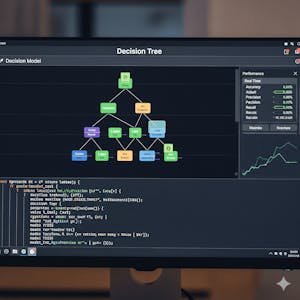
About this course
Unlock the power of decision tree modeling in R and learn how to build, evaluate, and interpret predictive models for both classification and regression tasks. This course provides a structured, hands-on introduction to decision trees, guiding you from core concepts and data preparation to implementing and assessing models using practical datasets. You will begin by understanding the fundamentals of decision trees, including the differences between classification and regression trees. As you progress, you will apply data preprocessing techniques such as encoding and feature preparation, then build and evaluate classifiers using the rpart package and confusion matrix analysis. The course also explores advanced applications, including prediction, visualization, splitting techniques, and working with multiple R packages such as tree for classification and regression modeling. Designed for beginners while remaining valuable for intermediate learners, this course combines conceptual understanding with step-by-step coding practice. By the end of the course, you will be able to preprocess data, create and evaluate decision tree models, apply them to real-world datasets, interpret results with confidence, and use R to support predictive modeling tasks. If you want to strengthen your machine learning skills in R through practical decision tree modeling, this course provides a clear and progressive learning path.
What you'll learn
- build decision tree models using R
- evaluate models with confusion matrix analysis
- understand the difference between classification and regression trees
- apply data preprocessing techniques
- interpret the results of decision tree models
Course objectives
- to provide a structured introduction to decision trees
- to develop practical skills in R for predictive modeling
- to equip learners with the ability to apply decision trees to real datasets
Skills you'll gain
Related courses
Data Science Foundations
USD 49
Machine Learning for Trading
USD 49

DataPrep for H2O Driverless AI
USD 49

The Complete Quantum Computing Course
USD 199.99

Internet of Things and AI Cloud
USD 49

Statistical Learning for Data Science
USD 49

Applied Natural Language Processing in Engineering Part 2
USD 49

Cloud Machine Learning Engineering and MLOps
USD 49
Course details are provided by the platform and may change — always confirm on the provider's site. Links may be affiliate links.