Material Behavior
Enroll now →
About this course
Have you ever wondered why ceramics are hard and brittle while metals tend to be ductile? Why some materials conduct heat or electricity while others are insulators? Why adding just a small amount of carbon to iron results in an alloy that is so much stronger than the base metal? In this course, you will learn how a material’s properties are determined by the microstructure of the material, which is in turn determined by composition and the processing that the material has undergone. This is the first of three Coursera courses that mirror the Introduction to Materials Science class that is taken by most engineering undergrads at Georgia Tech. The aim of the course is to help students better understand the engineering materials that are used in the world around them. This first section covers the fundamentals of materials science including atomic structure and bonding, crystal structure, atomic and microscopic defects, and noncrystalline materials such as glasses, rubbers, and polymers.
What you'll learn
- understand the relationship between material properties and microstructure
- explain the differences in behavior between materials like metals, ceramics, and polymers
- analyze the impact of atomic structure and defects on material performance
Course objectives
- help students grasp the fundamentals of materials science
- prepare learners for more advanced studies in materials engineering
- foster a deeper appreciation for the materials used in everyday applications
Skills you'll gain
Related courses

Physics of Oscillators and Waves
USD 49
Introduction to High-Throughput Materials Development
USD 49

Ethics in Engineering
USD 49
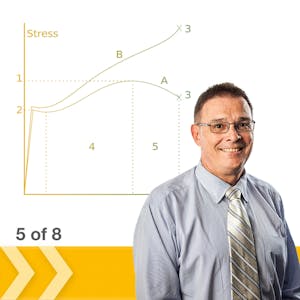
Mechanics of Materials I: Fundamentals of Stress & Strain and Axial Loading
USD 49

Building Robots: from Mechatronic Components to Robotics
USD 540
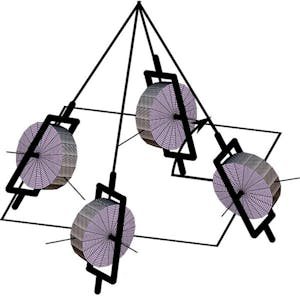
Advanced Spacecraft Dynamics and Control
USD 49

Crashkurs Technische Mechanik 1 (Statik)
USD 39.99
Introduction to Mechanics
USD 49
Course details are provided by the platform and may change — always confirm on the provider's site. Links may be affiliate links.