Practical Deep Learning with Python
Enroll now →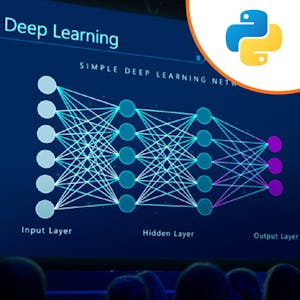
About this course
Gain hands-on experience in deep learning with Python and learn to design, train, and optimize advanced neural networks for real-world artificial intelligence applications. This course is ideal for data scientists, machine learning engineers, and AI enthusiasts who want to enhance their skills in building intelligent systems using Python. Throughout this deep learning training, you’ll explore how to model and analyze complex datasets with techniques widely applied in computer vision, natural language processing, and predictive analytics. You’ll also develop the ability to solve large-scale data problems and uncover actionable insights through deep learning. By the end of the course, you will be able to: - Explain the foundational components of deep learning models and their significance in artificial intelligence. - Apply Convolutional Neural Networks (CNNs), R-CNNs, and Faster R-CNNs for object detection and image-related applications. - Recognize the limitations of Perceptrons and implement Multi-Layer Perceptrons (MLPs) for improved data modeling. - Build and apply Recurrent Neural Networks (RNNs) and Long Short-Term Memory (LSTM) architectures for sequential and time-series data. - Optimize, evaluate, and fine-tune neural networks to improve accuracy, efficiency, and scalability. This course is designed for professionals and learners with a working knowledge of Python and machine learning who are ready to expand into deep learning and artificial intelligence. Experience with Python programming, statistics, and prior machine learning projects will be helpful in making the most of this training. Begin your journey into deep learning with Python and strengthen your ability to build advanced AI systems that solve real-world problems and power the future of intelligent technologies.
What you'll learn
- Explain foundational components of deep learning models
- Apply Convolutional Neural Networks (CNNs) for image-related tasks
- Implement Multi-Layer Perceptrons (MLPs) for data modeling
- Build Recurrent Neural Networks (RNNs) for sequential data
- Optimize neural networks for improved performance
Skills you'll gain
Related courses

파이썬(Python) 딥러닝(Deep Learning,DL) 프로젝트 - 딥러닝 모델 입문
USD 64.99
Advanced Deep Learning Methods for Healthcare
USD 79
Natural Language Processing in TensorFlow
USD 49

Deep Learning Applications for Computer Vision
USD 49
Deep Learning for Natural Language Processing
USD 49
Deep Learning Methods for Healthcare
USD 79

TensorFlow 2 for Deep Learning
USD 49

Ultimate Neural Nets and Deep Learning Masterclass in Python
USD 189.99
Course details are provided by the platform and may change — always confirm on the provider's site. Links may be affiliate links.