Real-Time Embedded Systems Theory and Analysis
Enroll now →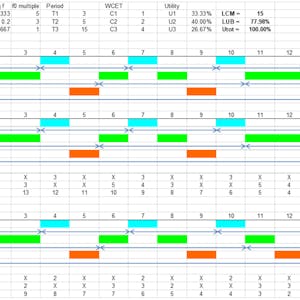
About this course
This course can also be taken for academic credit as ECEA 5316, part of CU Boulder’s Master of Science in Electrical Engineering degree. This course provides an in-depth and full mathematical derivation and review of models for scheduling policies and feasibility determination by hand and with rate monotonic tools along with comparison to actual performance for real-time scheduled threads running on a native Linux system. By the end of this course the learner will be able to full derive the fixed priority rate monotonic least upper bound for feasibility as well as justifying the rate monotonic policy and will be able to compare to dynamic priority scheduling including earliest deadline first and least laxity policies. At the end of this course learners will be able to fully derive and explain the math model for the rate monotonic least upper bound as well as performing timing diagram analysis for fixed and dynamic priority software services. Tools to provide analysis will be learned (Cheddar) to automate timing analysis and to compare to actual performance. Specific objectives include: ● Rate monotonic theory (complete math models) ● Differences between fixed priority rate monotonic policy and dynamic priority earliest deadline first and least laxity policies ● Scheduling theory and practice writing code for multi-frequency executives, priority preemptive RTOS services, and real-time threaded services on traditional operating systems (Linux) ● Building a simple Linux multi-service system using POSIX real-time extensions on Raspberry Pi 3b using sequencing and methods to log and verify agreement between theory and practice ● Timing diagram generation and analysis using Cheddar This course includes specific hardware and software requirements. Please review the FAQ below for complete details.
What you'll learn
- derive the fixed priority rate monotonic least upper bound for feasibility
- justify the rate monotonic policy
- compare fixed and dynamic priority scheduling
- perform timing diagram analysis for fixed and dynamic priority software services
- use Cheddar for timing analysis
Course objectives
- understand rate monotonic theory and complete math models
- write code for multi-frequency executives and real-time threaded services
- build a Linux multi-service system using POSIX real-time extensions
Skills you'll gain
Related courses
Sensor Manufacturing and Process Control
USD 99

Physics 102 - Magnetic Fields and Faraday's Law
USD 49

Master FPGA design with VHDL : Image transfer with UART
USD 49.99

YAKLAŞIK MALİYET-İÇ TESİSAT-KOMPANZASYON-TEKLİF HAZIRLAMA
USD 184.99

Techniques of Design-Oriented Analysis
USD 99

Developing Industrial Internet of Things
USD 79

Modeling and Control of Power Electronics
USD 79

Advanced Embedded Linux Development
USD 79
Course details are provided by the platform and may change — always confirm on the provider's site. Links may be affiliate links.