Systems Thinking In Public Health
Enroll now →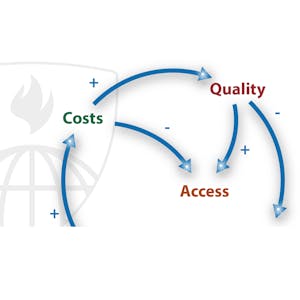
About this course
This course provides an introduction to systems thinking and systems models in public health. Problems in public health and health policy tend to be complex with many actors, institutions and risk factors involved. If an outcome depends on many interacting and adaptive parts and actors the outcome cannot be analyzed or predicted with traditional statistical methods. Systems thinking is a core skill in public health and helps health policymakers build programs and policies that are aware of and prepared for unintended consequences. An important part of systems thinking is the practice to integrate multiple perspectives and synthesize them into a framework or model that can describe and predict the various ways in which a system might react to policy change. Systems thinking and systems models devise strategies to account for real world complexities. This work was coordinated by the Alliance for Health Policy and Systems Research, the World Health Organization, with the aid of a grant from the International Development Research Centre, Ottawa, Canada. Additional support was provided by the Department for International Development (DFID) through a grant (PO5467) to Future Health Systems research consortium. © World Health Organization 2014 All rights reserved. The designations employed and the presentation of the material in this publication do not imply the expression of any opinion whatsoever on the part of the World Health Organization concerning the legal status of any country, territory, city or area or of its authorities, or concerning the delimitation of its frontiers or boundaries. Dotted and dashed lines on maps represent approximate border lines for which there may not yet be full agreement. The mention of specific companies or of certain manufacturers’ products does not imply that they are endorsed or recommended by the World Health Organization in preference to others of a similar nature that are not mentioned. Errors and omissions excepted, the names of proprietary products are distinguished by initial capital letters. All reasonable precautions have been taken by the World Health Organization to verify the information contained in this publication. However, the published material is being distributed without warranty of any kind, either expressed or implied. The responsibility for the interpretation and use of the material lies with the reader. In no event shall the World Health Organization be liable for damages arising from its use. Johns Hopkins University Bloomberg School of Public Health has a non-exclusive license to use and reproduce the material.
What you'll learn
- understand systems thinking principles
- identify complex interactions in public health issues
- develop frameworks for policy analysis
- anticipate unintended consequences of health policies
Course objectives
- introduce systems thinking in public health
- teach the integration of multiple perspectives
- provide tools for modeling public health systems
Skills you'll gain
Related courses

Global Sodium Reduction Strategies
USD 49

Geographic Information Systems (GIS)
USD 49

How Vaccines Work
USD 49

Your Body in the World: Adapting to Your Next Big Adventure
USD 69

Understanding the Healthcare Innovation Process II
USD 49

The Emergence of Oncofertility (Past, Present & Future)
USD 49

PrEParing: PrEP for Providers and Patients
USD 49
The Social Context of Mental Health and Illness
USD 49
Course details are provided by the platform and may change — always confirm on the provider's site. Links may be affiliate links.