You got the scholarship. Full tuition, maybe a stipend, maybe housing. Months of applications, essays, recommendation letters — and it paid off. Congratulations. Seriously.
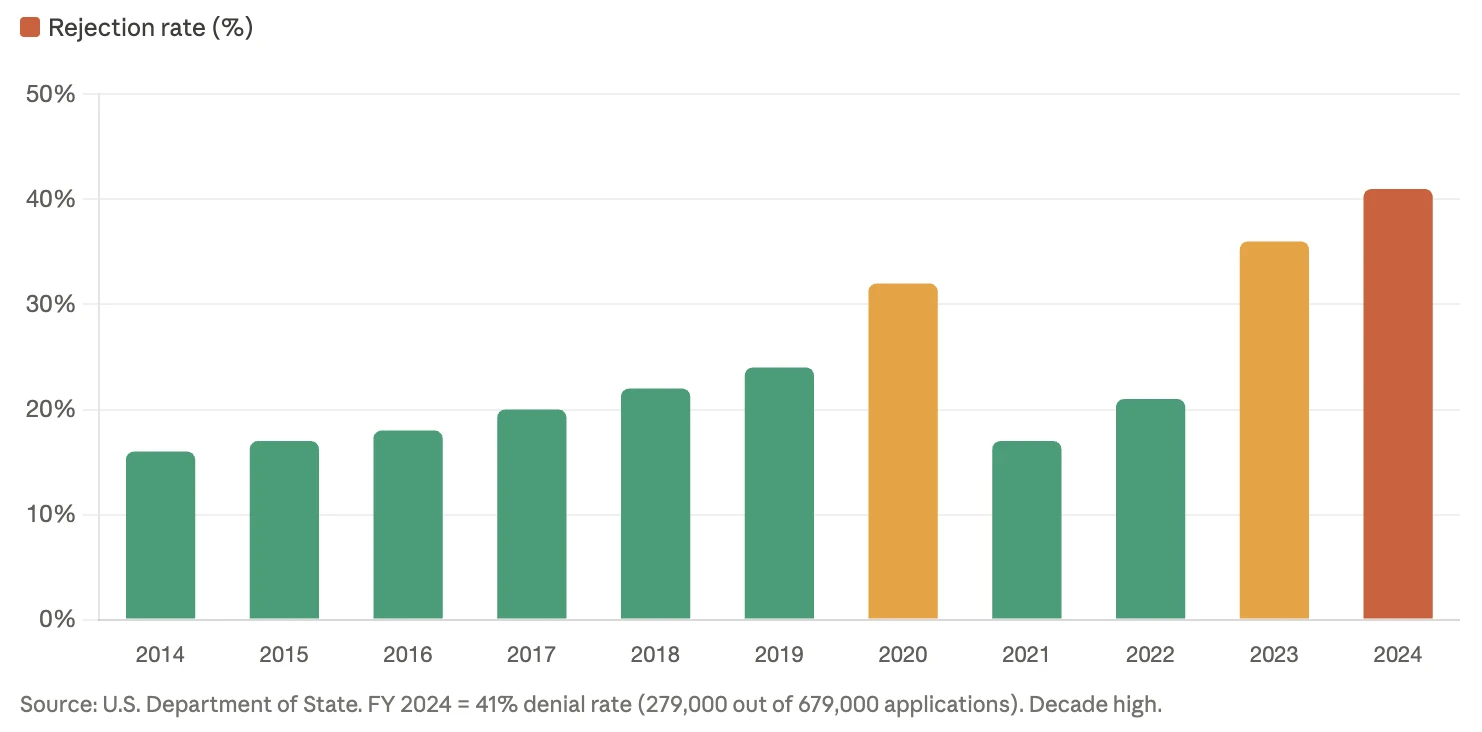
Now here's the part nobody warns you about: 41% of F-1 visa applications were denied in FY 2024. That's the highest rejection rate in a decade. And having a scholarship doesn't make you immune. Not even close.
The consular officer doesn't care who's paying your tuition. They care about one thing: are you coming back home after graduation? Your scholarship is a piece of that puzzle — a strong piece — but it's not the whole picture.
This guide covers the exact questions officers throw at scholarship students, the mistakes that get funded applicants rejected, and how to walk into that 2-minute conversation ready to walk out with an approved visa.
The scholarship trap: why funded students still get rejected
Here's a scenario that plays out at US consulates every single day. A student from Nigeria, India, or Bangladesh walks in with a fully funded scholarship from a respected American university. Great grades. Clean record. Solid financials. And walks out with a 214(b) rejection slip.
Why? Because the officer asked "What will you do after graduation?" and the student said something like:
"I want to gain experience in the US and explore opportunities."
Game over. That answer signals immigrant intent — the exact thing the officer is trained to detect.
A scholarship proves someone else believes in your academic potential. It does not prove you'll get on a plane back home when your program ends. That's on you to demonstrate.
The questions they'll actually ask you
The interview lasts 2-3 minutes. Sometimes less. Here's what to expect, broken into the categories officers use internally.
Funding questions (expect these first)
| Question | What the officer is really asking |
|---|---|
| "How will you fund your education?" | Do you actually understand your own financial arrangement? |
| "What's the name and amount of your scholarship?" | Is this real, and do you know the details? |
| "What does the scholarship cover specifically?" | Tuition only? Housing? Stipend? Insurance? |
| "Why did the university give you this scholarship?" | Were you selected on merit, or is this suspicious? |
| "What happens if your scholarship is revoked?" | Do you have a backup plan, or are you stuck? |
That last one catches a lot of people off guard. A former US consular officer who reviewed over 70,000 visa cases put it bluntly: scholarships can be revoked — officers want to know you've thought about what happens if they are.
How to answer: Be specific. Not "I have a scholarship" but "I received the Chancellor's Merit Award from [University], covering full tuition of $52,000 per year plus a $2,000 monthly stipend. I was selected based on my research in computational biology and a 3.9 GPA." That level of detail signals legitimacy.
For the revocation question, have a real answer: "My parents have pre-approved an education loan of $X with [Bank], and we have family savings that could cover one year of expenses." Vague answers here raise doubts about whether the scholarship itself is genuine.
"Why this university?" (the make-or-break question)
This is where most scholarship students bomb — and it's the question officers rank as the single strongest signal of a real vs. fake application.
Gets you rejected: "It's a highly ranked university with a good reputation."
Gets you approved: "I chose UW-Madison specifically for Dr. Chen's lab in microbial genomics. Their CRISPR research on antibiotic resistance aligns directly with my thesis work. Plus, the Biotechnology Center offers a practicum that no program in my country has."
See the difference? One answer could apply to 500 universities. The other could only come from someone who's actually done the research.
If you can't name at least one professor, one specific course, and one unique feature of your program — you're not ready for the interview.
Post-graduation intent (the danger zone)
This is where the 214(b) rejections live. The officer needs to believe you'll leave the US after your degree.
Safe answers mention:
- A specific industry or employer in your home country
- Family obligations (business, dependents, property)
- How your US degree fills a gap that serves your career back home
- Return-service obligations tied to your scholarship (if applicable — this is gold)
Dangerous answers include:
- "I want to explore opportunities in the US"
- "I'll do OPT and then see what happens"
- "The job market is better in America"
- Any hesitation or uncertainty about returning
Pro tip: If your scholarship has a return-home obligation (common with government scholarships like Türkiye Bursları, LPDP, or Saudi SACM), mention it explicitly. It's one of the strongest possible signals of non-immigrant intent.
Home ties and travel history
Officers will ask about family, property, and previous travel. The key rules:
- Never hide US-based relatives. Officers have databases. Getting caught lying triggers Section 212(a)(6)(C)(i) — permanent visa ineligibility.
- If your passport is blank, every other answer needs to be rock solid. No travel history means no proof you've ever left a country and come back.
- Own it if you've been denied before. Explain what's changed since then. Pretending it didn't happen is worse than addressing it head-on.
5 mistakes that get scholarship students denied
After analyzing dozens of rejection cases and expert interviews, these are the patterns:
Not knowing their own scholarship details. If you can't state the exact amount, coverage, duration, and renewal conditions on the spot — why would the officer believe it's real?
Giving coached, robotic answers. Officers hear the same YouTube-sourced phrases hundreds of times a day. "I chose this university because of Professor Smith's groundbreaking research" — when you've clearly never read a single paper by Professor Smith — is an instant credibility killer.
Mentioning work/immigration intent. Even casual references to H-1B, staying in the US long-term, or "better opportunities abroad" can flip a decision from approve to deny.
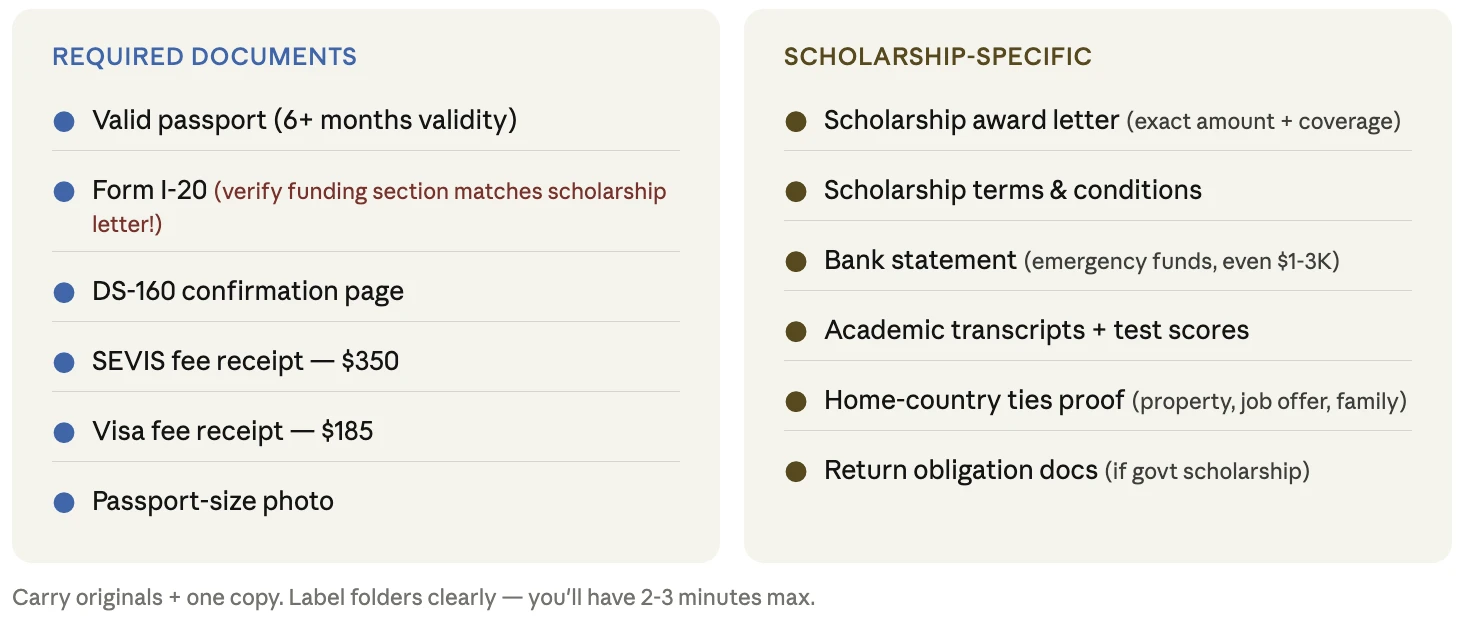
DS-160 contradictions. Since April 2025, the DS-160 barcode must match the one used to book your appointment. And any mismatch between what you wrote on the form and what you say in person — dates, program details, funding sources — creates doubt about your entire application.
Undeclared social media accounts. Under rules effective June 2025, all F/M/J applicants must declare every social media account since 2019 and set profiles to public. One Indian student was put on administrative hold simply for not disclosing a Reddit account — even though it contained nothing problematic.
How to actually prepare (not just read about it)
Reading interview questions is a start. But the real interview isn't a quiz where you recite memorized answers — it's a live conversation where the officer reacts to what you say and follows up unpredictably.
The students who get approved consistently describe the same preparation approach: practicing out loud, under pressure, with someone pushing back on their answers. Not reading. Not memorizing. Talking.
Some students practice with friends. Some use advisors at their university's international office. And increasingly, scholarship recipients are using tools that let them practice their F-1 visa interview with an AI consular officer — a voice-based simulation where the AI adapts to your answers, asks follow-ups, and applies the same kind of pressure you'll face at the embassy. It's closer to the real thing than any Q&A list can get.
Whatever method you choose, the goal is the same: your answers should sound natural, not rehearsed. Confident, not defensive. Specific, not generic.
The bottom line
Your scholarship is an advantage — a big one. It proves financial support, institutional backing, and academic merit. But it doesn't answer the question the consular officer actually cares about: why will you come back?
Prepare that answer. Make it specific. Make it honest. And practice saying it out loud until it sounds like something a real person would say — because that's exactly what the officer is listening for.
The interview is 2 minutes. Your scholarship took months to win. Don't let those 2 minutes undo all of it.