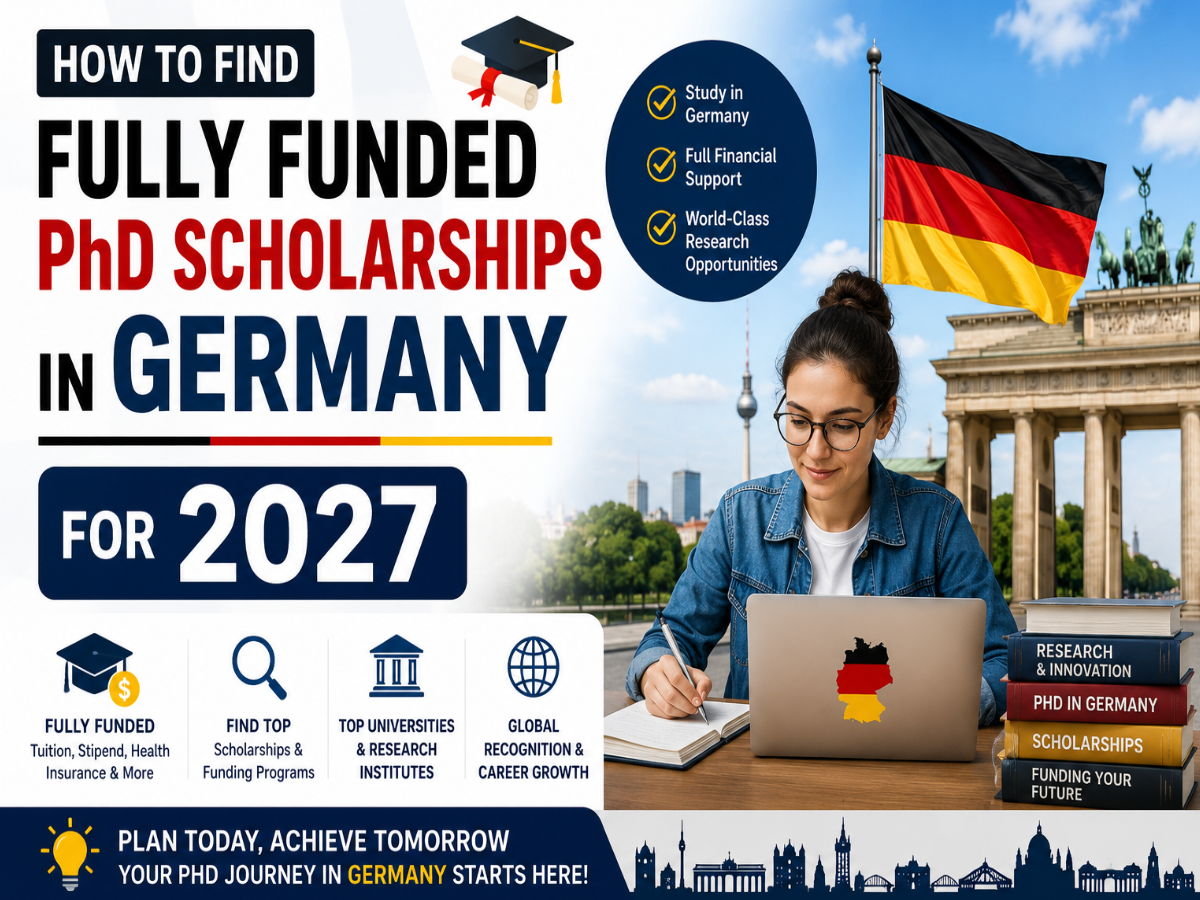
Germany has become one of the world’s leading destinations for doctoral research, attracting thousands of international students each year with fully funded PhD positions, research salaries, and globally respected universities. Unlike many countries where PhD candidates pay high tuition fees, Germany’s public universities and research institutes often provide funded doctoral opportunities with monthly stipends, employment contracts, and research grants.
For the 2027 intake, international students will find increasing opportunities in English-taught doctoral programmes across engineering, artificial intelligence, biotechnology, economics, environmental sciences, social sciences, and humanities. Research organizations such as the Max Planck Society, DAAD, Helmholtz Association, and Fraunhofer Institutes continue expanding international recruitment efforts to attract highly skilled researchers from around the world.
This guide explains how students can successfully find PhD scholarships in Germany, understand the funding system, identify suitable universities, and prepare competitive applications for 2027 admissions.
Why Germany Is a Top Destination for PhD Students
Germany offers several advantages for doctoral researchers compared to many other study destinations.
Tuition-Free Education
Most public universities in Germany charge little or no tuition fees for doctoral studies. Students usually only pay semester administrative fees.
Strong Research Infrastructure
Germany is home to internationally recognized research institutions including:
- Max Planck Society
- Fraunhofer Society
- Helmholtz Association
- Leibniz Association
These organizations provide advanced laboratories, research funding, and industry collaboration opportunities.
Fully Funded Opportunities
Many doctoral students receive:
- Monthly stipends
- Salaried research assistant contracts
- Health insurance support
- Travel grants
- Research funding
- Conference sponsorship
Post-Study Work Opportunities
Germany allows international graduates to stay for up to 18 months after graduation to search for employment, making it attractive for long-term career development.
Types of PhD Pathways in Germany
Germany mainly offers two doctoral pathways.
Individual Doctorate
The individual doctorate is Germany’s traditional PhD route. Students work independently under the supervision of a professor while conducting original research.
This option is ideal for students who:
- Already have a clear research topic
- Prefer flexible research structures
- Want independent academic work
Structured Doctoral Programmes
Structured programmes follow a more organized format with:
- Research teams
- Coursework
- Workshops
- Academic mentoring
- Fixed timelines
These programmes are often fully funded and highly international.
Best Places to Find PhD Scholarships in Germany
DAAD Scholarship Database
The German Academic Exchange Service scholarship portal is one of the best resources for international students seeking funded doctoral opportunities.
DAAD scholarships usually cover:
- Monthly stipend
- Health insurance
- Travel allowance
- Research grants
- Language courses
PhDGermany Portal
PhDGermany is designed specifically for international applicants and lists funded PhD vacancies across German universities and research institutes.
Students can search by:
- Subject area
- Institution
- Research field
- Funding type
Max Planck Research Schools
International Max Planck Research Schools (IMPRS) provide fully funded doctoral programmes in:
- Physics
- Artificial Intelligence
- Biology
- Neuroscience
- Chemistry
- Social Sciences
Most programmes are taught entirely in English.
University Websites
German universities regularly advertise doctoral positions on their official websites. Applicants should monitor university career portals and departmental announcements.
Popular Fields With High Funding Availability
Germany strongly funds research areas connected to innovation and industrial development.
Highly funded fields include:
- Artificial Intelligence
- Computer Science
- Renewable Energy
- Mechanical Engineering
- Biotechnology
- Data Science
- Environmental Sciences
- Physics
- Public Health
- Economics
Students in STEM disciplines often find more funded positions than applicants in non-technical fields.
Eligibility Requirements for PhD Scholarships
Requirements vary by programme, but most funded PhD opportunities require:
- A completed Master’s degree
- Strong academic performance
- Research experience
- English language proficiency
- Research proposal or statement of interest
- Recommendation letters
Some programmes may also require publications, coding experience, or laboratory skills depending on the field.
English Language Requirements
Most English-taught doctoral programmes accept:
- IELTS
- TOEFL
- Cambridge English certificates
Typical minimum requirements include:
- IELTS: 6.5 or higher
- TOEFL iBT: 90 or higher
German language skills are not always required, especially for international research programmes.
How to Contact Professors Successfully
For individual doctorates, contacting professors directly is extremely important.
A strong email should include:
- A short academic introduction
- Research interests
- Why the professor’s work matches your goals
- CV attachment
- Brief research idea
Applicants should avoid sending generic mass emails.
Professors are more likely to respond when students reference specific research papers or projects.
Documents Required for Application
Students commonly need:
- Academic transcripts
- Degree certificates
- CV
- Research proposal
- Motivation letter
- Recommendation letters
- English language test scores
- Passport copy
Some programmes may request writing samples or portfolios.
Funding and Monthly Stipends
Fully funded PhD scholarships in Germany generally provide between €1,300 and €2,700 per month depending on the institution and funding source.
Funding may come through:
- Scholarships
- Employment contracts
- Research assistantships
- EU-funded projects
Students working under university employment contracts may also receive pension and social security benefits.
Tips to Improve Your Chances
Students can improve their success rate by:
- Applying early
- Preparing a strong research proposal
- Contacting supervisors professionally
- Publishing research papers if possible
- Building relevant technical or laboratory skills
- Tailoring motivation letters for each programme
Consistency and preparation are critical because competition for fully funded doctoral positions is high.
Common Mistakes Applicants Should Avoid
Many applicants lose opportunities because they:
- Send generic emails to professors
- Apply without reading programme requirements
- Submit incomplete documents
- Miss application deadlines
- Write weak motivation letters
- Ignore research compatibility with supervisors
A well-prepared and focused application usually performs far better than applying randomly to many universities.
Final Thoughts
Germany continues to offer some of the best fully funded PhD opportunities in the world for international students. With tuition-free education, strong research funding, internationally recognized institutions, and excellent post-study career opportunities, the country remains highly attractive for doctoral researchers planning for the 2027 intake.
Students who begin preparing early, develop strong research interests, and apply strategically to suitable programmes will significantly increase their chances of securing a funded PhD position in Germany.